The science behind reliable power delivery — from advanced insulation systems to intelligent cable monitoring.
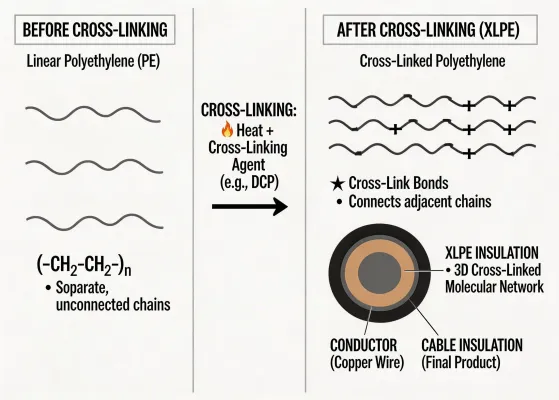
Cross-linked polyethylene (XLPE) insulation is the backbone of our medium and high voltage cable range. Through controlled peroxide cross-linking at temperatures exceeding 300°C, the molecular chains form a three-dimensional network that measurably improves thermal endurance, dielectric strength, and resistance to environmental stress cracking.
| Parameter | XLPE | PVC |
|---|---|---|
| Max. Continuous Temp. | 90°C | 70°C |
| Short Circuit Temp. | 250°C | 160°C |
| Dielectric Strength | >20 kV/mm | ~15 kV/mm |
| Design Life | 30+ years | 20 years |
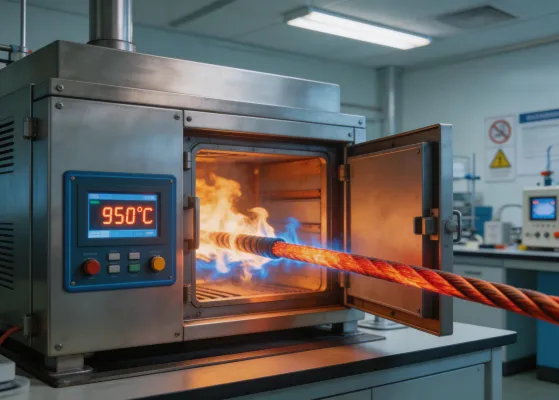
Our fire resistant cable range is tested beyond minimum compliance. We engineer cables to maintain circuit integrity under direct flame exposure for up to 120 minutes — exceeding the 30- and 60-minute thresholds required by most building codes.
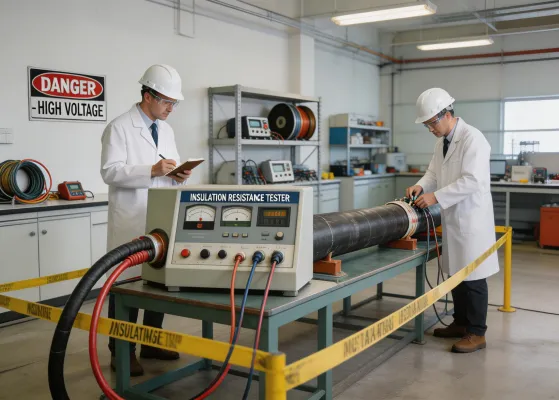
Every production batch undergoes a comprehensive testing regime in our ISO 17025 accredited laboratory. From routine high voltage withstand tests to partial discharge measurement, we verify that each cable leaving our facility meets or exceeds the stated specification.
Selecting the right insulation system requires balancing thermal performance, flexibility, cost, and installation constraints. No single insulation type is optimal for every application.
| Parameter | XLPE | EPR (Ethylene Propylene Rubber) | PVC |
|---|---|---|---|
| Max. Continuous Temperature | 90°C | 90°C | 70°C |
| Short-Circuit Temperature | 250°C | 250°C | 160°C |
| Flexibility (Bend Radius) | Moderate — stiffer at large cross-sections | High — preferred for confined routing | Moderate |
| Moisture Resistance | High (low dielectric loss) | Moderate (higher water absorption) | Moderate |
| Relative Cost | Medium | Higher (rubber compound processing) | Lowest |
| Typical Application | Utility distribution, direct burial | Mining, portable power, tight spaces | Low voltage building wiring |
EPR offers superior flexibility for retrofit installations in congested cable routes but has higher moisture absorption than XLPE, making it less suitable for long-term direct burial without additional moisture barriers. XLPE remains the default choice for new-build distribution networks where routing space is not constrained.
Cables manufactured to IEC 60502 and UL 1072 / UL 44 standards are not interchangeable despite serving similar voltage classes. Key differences affect project specifications:
Conductor sizing follows IEC 60228 classes (Class 2 stranded, Class 5 flexible). Insulation thickness is governed by IEC 60502 tables based on rated voltage Uo/U. Fire testing follows IEC 60332 (flame propagation) and IEC 60331 (circuit integrity) independently. Widely specified in Europe, Middle East, Africa, and Asia-Pacific projects.
Conductor sizing follows AWG/kcmil system. Insulation requirements per UL 1072 include additional impact and crush resistance tests not present in IEC. Installation governed by NEC (National Electrical Code) articles 310/311. Required for all North American installations and many Caribbean/Latin American projects referencing NEC.
Projects spanning IEC and UL jurisdictions require dual-certified cables or parallel specifications. Nexans Cables maintains both IEC and UL product lines to support multinational project delivery without re-certification delays.
Download product datasheets, installation guides, and IEC compliance documentation for your project specifications.
Request Technical Documents